¶Life shaped the Earth. Biology and geology seem to operate on dramatically different time scales, but on Earth, they are intimately linked. For example, limestone, and thus its metamorphic form, marble, is made of calcium carbonate, often from deposits accumulated by corals, mollusks, and single-celled organisms (for example, the pyramids of Egypt are made almost entirely of fossilized foraminifera). The cherts of the Bay Area are accumulations of microscopic radiolarian and diatom skeletons, sometimes with traces of the oil they once used for buoyancy. Meanwhile, life also shapes our climate and landforms, with vegetation changing erosional patterns, turning badlands into jungles, and over eons, shaping mountain ranges themselves. Cycles of global glaciation, both ancient and more recent, may be caused by the biosphere’s uptake of CO2. It’s even possible that, without life, a runaway greenhouse effect could have dried up the oceans and left Earth looking something like Venus—and without oceans enabling flux melting of subducting oceanic crust, arc volcanism may also have stopped. Biology terraformed our planet. Life may also enable planets outside of their stars’ nominal habitable zones to become habitable (paper). |
|
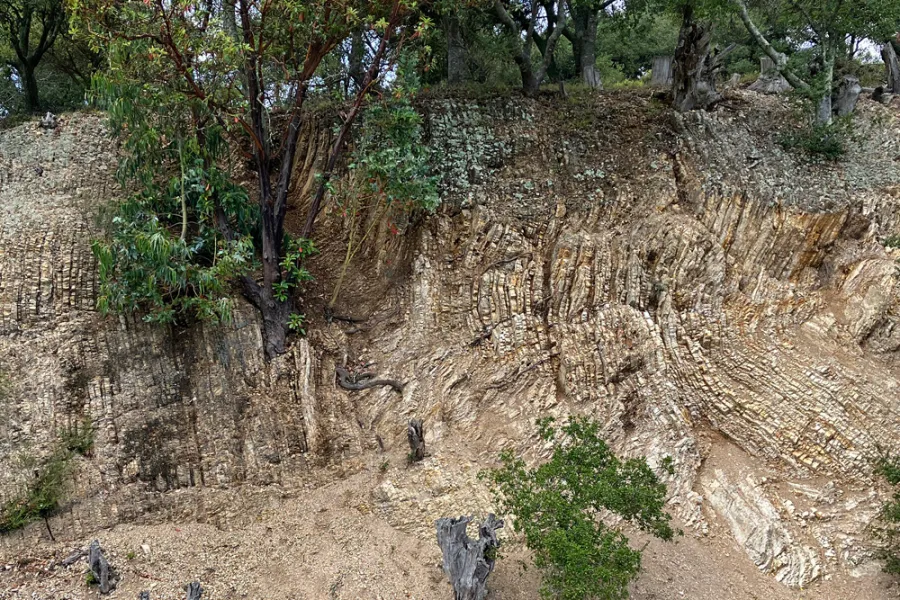 | Chert on Skyline Boulevard in the East Bay hills above Oakland, CA. Image credit: Andrew Alden of the excellent Oakland Geology blog (and book). |
|
The Orbital Index is made possible through generous sponsorship by:
 
 |
|
| ¶Scaling a space business often means investing heavily in equipment and technology long before revenue arrives. For nearly 40 years, CSC Leasing has helped deep-tech and space-tech teams acquire the labs, test gear, and manufacturing tools they need without burning equity on depreciating assets. Our flexible, non-dilutive financing preserves cash while adapting to the rapid, iterative cycles of frontier engineering. With a self-funded model and lease lines ranging from $100K to $50M, CSC equips innovators to build, test, and launch what’s next. Thank you, Orbital Index, for providing reliable news and updates for the last 7 years! |
|
¶Life shapes our atmosphere. For most of Earth’s history, the sky would have been hostile to us. The Great Oxidation Event marks the moment biology (starting with microbes) pushed oxygen levels high enough to permanently alter the planet’s chemistry, creating an oxygenated atmosphere and an ozone layer that allowed aerobic life to flourish. The modern biosphere maintains this breathable atmosphere, and also releases other consequential (if sometimes strange) emissions: forests produce isoprene, a biogenic volatile organic compound, whose oxidation products can drive new particle formation in the upper troposphere (recently reproduced in CERN’s CLOUD chamber – paper), creating condensation nuclei that seed cloud formations. Carbonyl sulfide (COS/OCS) is even more interesting: sea animal colonies can shift Antarctic tundra soils from being an OCS absorber to an emitter by altering soil chemistry and microbial communities (e.g., penguins pooping and walking around on the tundra). Plants are typically a one-way absorber of OCS, making it a marker for photosynthetic carbon dioxide uptake and useful for estimating gross primary production that is more in line with other estimates than existing photosynthesis estimation methods (~120 PgC annually traditionally vs 157 ± 8.5 PgC via OCS – paper). These and other fluxes build into a non-mystical, feedback-only version of the Gaia hypothesis developed by Lynn Margulis and James Lovelock: life and environment co-evolved into coupled feedback loops that can stabilize (or destabilize) our planet’s atmospheric states (without any need to claim purpose, a point of common criticism). And, the Gaia hypothesis can be turned outward: Lovelock’s intuition is that a planet-scale biosignature is atmospheric disequilibrium: look for combinations of gases that shouldn’t persist together without a large, continuous source—in our case, life. Which brings us to the sobering present: Ben recently read Gwynne Dyer’s excellent Intervention Earth, which makes it hard to avoid the conclusion that humanity—having attained a geologic-scale atmospheric impact—may end up having to intervene more heavily in atmospheric chemistry and radiative balance than any of us would like, not because it’s appealing or elegant, but because our timeline doesn’t allow for anything less. |
|
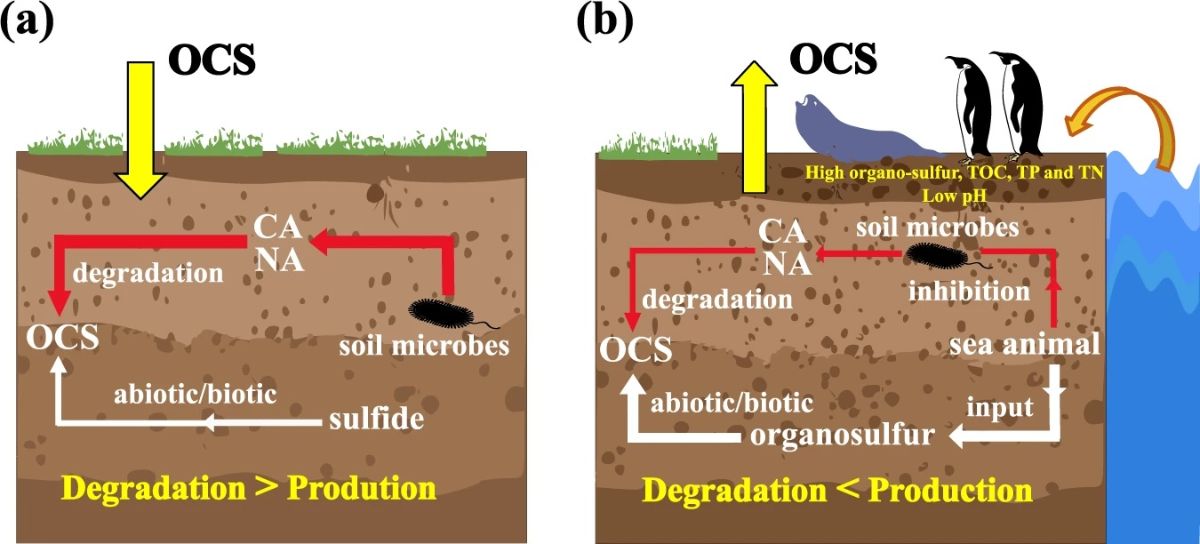 | In this diagram, penguins jumping on land scare a sea lion and squeeze OCS out into the atmosphere… or something. |
|
¶Life shaped our minerals. Life’s machinations also resulted in many of our minerals. It’s well known that coal, oil, and natural gas, the fuels of humanity’s rise (and maybe demise), are carbonized organic compounds built from CO2 that was reduced by plants and algae. Less well known are the banded iron deposits from the Great Oxidation Event, which are a key source of iron for industry. These were formed when life added oxygen to our air, creating our protective ozone layer and rusting the planet (more above). This life-derived oxygen is one of the reasons Earth has 6,188 officially known minerals, while Mars has 161—a majority of our minerals may exist only due to the free oxygen made available by life. (Mars surely has more, but we won’t find them until we can stumble around and hammer on rocks.) Also likely due to life: a large amount of our native sulfur (although we’ve seen some on Mars); bog iron ore (one of the first sources of iron for tool making) which is often concentrated by iron-oxidizing bacteria; abelsonite, a chlorophyll-like mineral likely derived from the breakdown of ancient vegetation; and, even the bioaccumulation and formation of uranium, phosphate, vanadium and gold deposits—“bacteria and archaea are involved in every step of the biogeochemical cycle of gold, from the formation of primary mineralization in hydrothermal and deep subsurface systems to its solubilization, dispersion and re-concentration as secondary gold under surface conditions.” Related: About 4% of minerals are now the direct result of human activity—known as anthropocene minerals, these occur in places like mine walls, shipwrecks, and ancient slag (paper). Andrew recently thoroughly enjoyed reading The Story of Earth by Robert M. Hazen, the author of that anthropocene minerals paper and an explorer of mineral evolution. Recommended! |
|
‹Support Us› Orbital Index is made possible by readers like you. If you appreciate our writing, please support us with a monthly membership! |
|
| ¶News in brief. Jared Isaacman was finally confirmed as NASA’s 15th administrator—here’s to hoping there’s a reasonable chunk of NASA left for him to administer ● Trump signed the ‘Ensuring American Space Superiority’ executive order which effectively ends the National Space Council (consolidating under the White House Office of Science and Technology Policy) and puts ambitious dates on numerous goals: an American Moon landing (2028), the starts of a lunar base including a nuclear surface reactor (2030), a “Golden Dome” test (2028), a pathway for commercial ISS replacement by 2030, and more ● HawkEye 360 raised a $150M Series C ● Starfighters Space went public, raising $40M to accelerate development of their supersonic aircraft capable of sub-orbital launches ● Innospace (c.f. Issue 342) attempted the first orbital launch from Brazil this week (and the first private South Korean orbital launch attempt), but their Hanbit rocket failed roughly one minute into flight ● Indian startup Digantara closed $50M Series B to use their situational awareness satellites for missile defense ● EraDrive raised a $5.3M Seed to scale the production of its self-driving modules that allow satellites to maneuver autonomously ● Tony Bruno, the president and CEO of ULA, stepped down from his role after 12 years—we’ll miss his fun, positive, and candid play-by-play of the industry and ULA’s part in it ● Despite Roscosmos anticipating fixes by the end of February 2026, NASA has bumped up Dragon ISS resupply missions due to the recent Soyuz launch pad incident in Baikonur ● Rocket Lab executed its first dedicated launch for JAXA aboard Electron, which is now at a record 19 launches on the year for the mature vehicle ● Startup Max Space unveiled plans for a commercial space station, with a single module that can launch on a Falcon 9 and expand to 350 cubic meters once in orbit ● Japan’s new-ish H3 rocket suffered an anomaly in the upper stage, failing to place a navigation satellite in a high enough orbit ● SpaceX confirmed IPO prep for 2026 ● One of NASA’s ESCAPADE spacecraft experienced lower-than-expected thrust during a burn, delaying its trajectory correction maneuver ● As NASA’s MAVEN spacecraft remains unresponsive and likely unstable, another Mars circling spacecraft (the Mars Reconnaissance Orbiter) continues to operate nominally, recently capturing its 100,000th surface image using the HiRISE camera. |
|
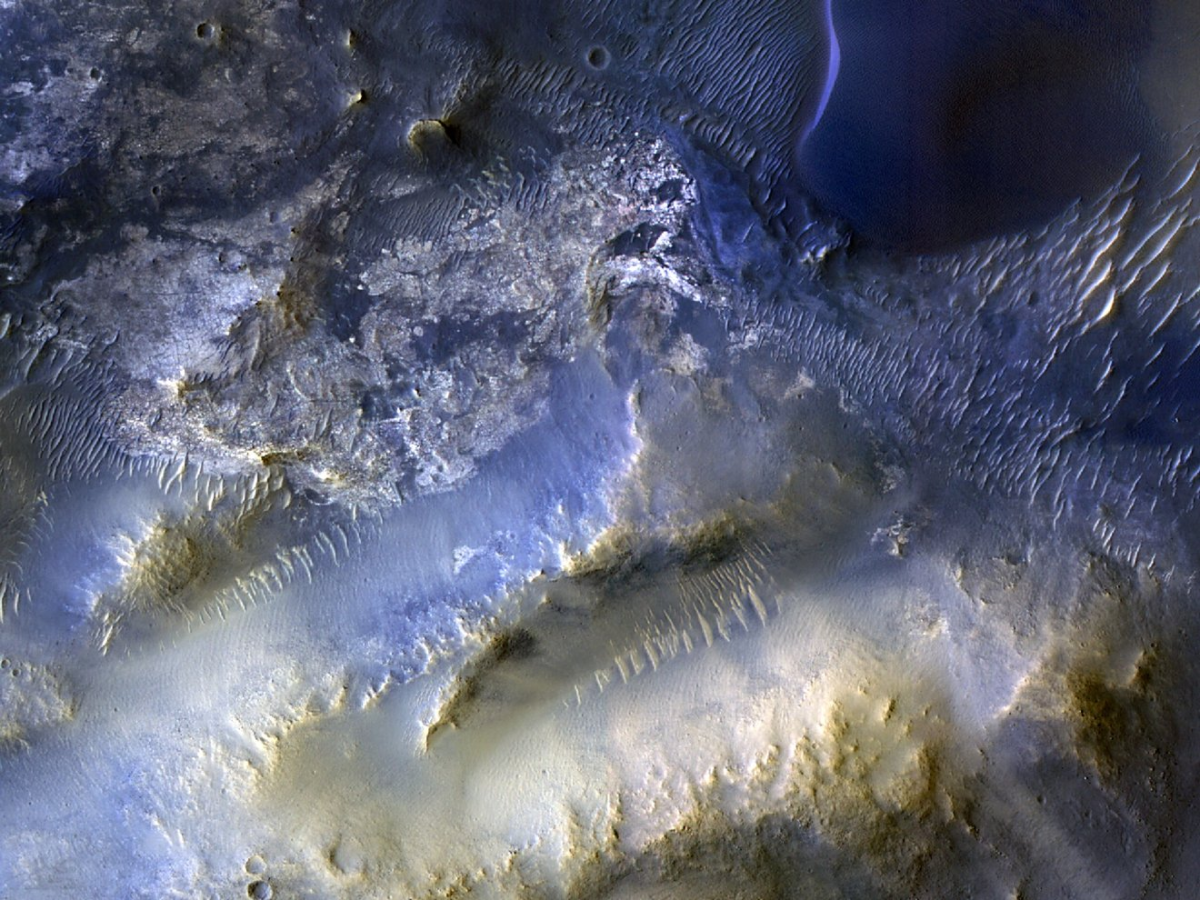 | A view of the region called Syrtis Major, created by a massive shield volcano, is shown in MRO’s 100,000th image from its HiRISE camera. Credit: NASA |
|
¶Etc.- A recent study shows that even the Earth’s lower mantle has been affected by life, finding that diamond-bearing volcanic kimberlites from deep within the mantle exhibit a different carbon signature if they formed after the rapid development of fauna in the Cambrian Explosion. This is because seafloor sediments containing biological matter were subducted at plate boundaries and ended up deep in the mantle in kimberlites.
- There's a 'Subterranean Galapagos' deep inside the Earth, and studying 1.6 billion-year-old water from a Canadian mine.
- CERN provides free instructions on how to build a cloud chamber at home.
- Blue Origin’s latest New Shepard flight included ESA aerospace and mechatronics engineer Michaela Benthaus, who is likely the first wheelchair user to cross the Kármán line.
- Interstellar comet 3I/ATLAS made its closest approach to Earth on Dec 19th, roughly 270 million kilometers away.
- Jatan Mehta shared a year-end “Achievements and shortfalls in global lunar exploration in 2025.”
- Katalyst Space selected Northrop Grumman’s Pegasus XL air-launched rocket (last flown in 2021) to deliver its robotic spacecraft to orbit for its NASA mission to boost Swift’s orbit, which is currently at too low of an inclination for most small rockets to reach from their designated launch sites.
- The stuff of nightmares: a 10 million solar mass black hole moving at 1,000 km/s (paper). This is the first confirmed runaway supermassive black hole, and it is pushing a massive bow shock in front of it while dragging a 200,000 light-year-long tail behind. Supermassive black holes moving at 0.003 c might be hazardous to your health.
- Plate tectonics, meanwhile, may increase the probability of life by “forming geological structures such as mountains, volcanoes and oceans, which also allow moderate weather and climate patterns to develop. Through weathering, nutrients are released into oceans. By creating and destroying habitats, plate tectonics puts moderate but incessant environmental stress on species to evolve and adapt.” The probable rarity of plate tectonics in the galaxy is even proposed as an addition to the Drake equation (paper). Our own planet’s plate tectonics may have been jump-started by impacts, with chemical traces in zircon crystals aligning with the period when “our Solar System passed through the galaxy’s spiral arms, which are densely packed with stars and gas. In these crowded regions, extra gravitational forces may have disturbed icy comets at the edge of our Solar System, knocking some onto paths that sent them crashing into Earth.” Time for the field of paleoastrobiogeology!
|
|
Plumes of water spewing from Saturn’s icy moon Enceladus show signs of even more molecules useful for life: aromatics like benzene, oxygen compounds, and esters and alkenes, including molecules which play a role in amino acid chemistry, all consistent with the presence of hydrothermal activity. This new data comes from the re-analysis of an old Cassini flyby in 2008, when the spacecraft, moving at ~18 km/s, collided with and ionized water vapor from the plumes, revealing signatures of its component molecules (paper). XKCD #2359, below, seems apropos. |  |
|
|